


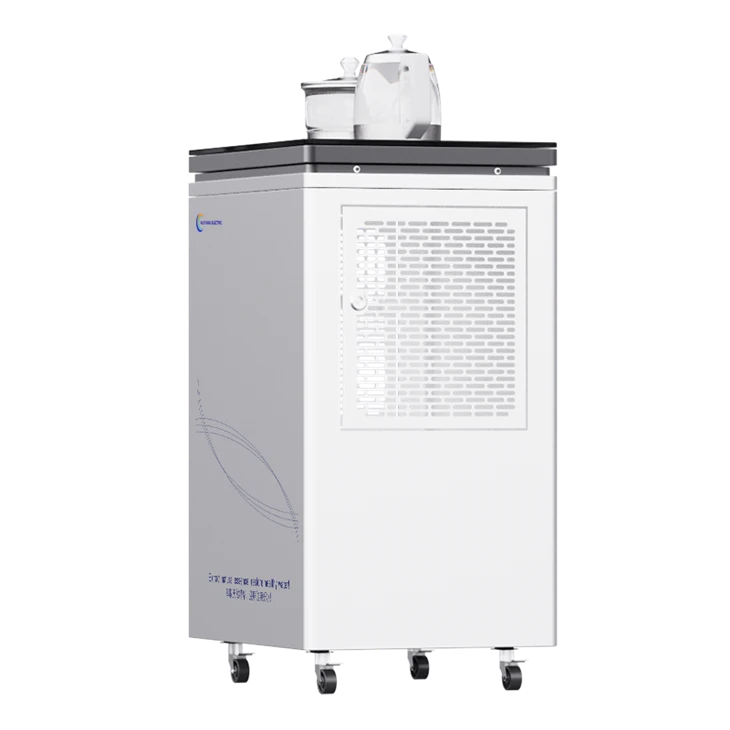
Commercial Air-to-Water Generator
Description
Technical Parameters
The Industrial Commercial Air-to-Water Generator (AWG) extracts moisture directly from ambient air to deliver a continuous, decentralized supply of potable bulk water. Engineered for commercial facilities, remote operations, and municipal emergency reserves, this system bypasses municipal water infrastructure dependency.
Built around heavy-duty refrigeration cycles and multi-barrier water purification trains, the unit operates continuously across wide climatic ranges, converting atmospheric humidity into high-purity drinking water that complies with WHO and EPA standards.
Key Features
High-Volume Daily Yield: Continuous bulk water generation rated from 500 L up to 5,000 L per day, supported by integrated insulated stainless steel storage tanks.
Energy-Optimized Refrigeration: Utilizes industrial-grade variable-speed compressors and hydrophilic-coated aluminum fin evaporators to maximize condensation efficiency per kilowatt-hour (kWh/L).
7-Stage Medical-Grade Filtration: Removes particulate matter, heavy metals, volatile organic compounds (VOCs), bacteria, and viruses via sediment filtration, Reverse Osmosis (RO), Mineralization, and UV/Ozone sterilization.
All-Weather Operational Range: Functions reliably across ambient temperatures from 15°C to 45°C and relative humidity levels from 30% to 95%.
PLC Intelligent Control: Automated monitoring of water level, TDS, filter lifecycle, and self-flushing cycles via an industrial HMI touchscreen with Modbus/IoT remote telemetry integration.
Technical Specifications
|
Parameter |
Standard Commercial Unit (AWG-500) |
Industrial High-Capacity Unit (AWG-2000) |
|
Daily Water Production |
500 L/day (approx. 132 GPD at 30°C, 80% RH) |
2,000 L/day (approx. 528 GPD at 30°C, 80% RH) |
|
Rated Power Consumption |
12.5 kW |
48.0 kW |
|
Power Supply |
380V/415V (or 208V–480V customizable), 50/60Hz, 3-Phase |
380V/415V (or 208V–480V customizable), 50/60Hz, 3-Phase |
|
Refrigerant |
R410a / R407c |
R410a / R407c |
|
Water Storage Capacity |
300 L Food-Grade SUS304 Tank |
1,500 L Food-Grade SUS304 Tank |
|
Filtration Sequence |
Air Dust Filter → RO → Post-Carbon → UV → Ozone |
Air Dust Filter → Ultrafiltration → RO → Mineralization → UV → Ozone |
|
Operating Noise Level |
≤ 68 dB(A) at 1 meter |
≤ 75 dB(A) at 1 meter |
|
Dimensions (L × W × H) |
1,800 × 1,100 × 2,100 mm |
3,200 × 1,800 × 2,400 mm |
|
Unit Dry Weight |
650 kg |
2,100 kg |
Applications
Remote Industrial Camps: Provides independent drinking water security for mining, oil & gas, and infrastructure construction sites lacking municipal water pipelines.
Commercial Real Estate & Office Complexes: Supplements green building water supply, lowering municipal utility footprints and ensuring resilient emergency reserves.
Island Resorts & Coastal Facilities: Solves acute freshwater scarcity in saline groundwater regions without costly reverse-osmosis seawater desalination intake plants.
Municipal Disaster Relief: Rapidly deployable on standard flatbed trailers to supply immediate potable water following natural disasters or grid failures.
Customization and OEM/ODM
Manufacturing operations are supported by a 15,000 m² fabrication facility equipped with CNC laser cutting machines, CNC sheet metal bending centers, automated copper tube bending equipment, and dedicated refrigerant charge and vacuum testing lines.
Containerized enclosures (ISO 20ft/40ft CSC-certified) for mobile deployment, or skid-mounted configurations for rooftop/mechanical room integration.
Custom voltage windings compliant with UL, CE, and IEC industrial electrical standards.
Seawater-resistant marine-grade aluminum evaporator coatings and 316L stainless steel hydraulic piping for corrosive coastal environments.
Private-label HMI interface software, custom sheet metal color powder-coating, and localized user manual documentation.
Quality Control and After-Sales Support
Factory compliance is enforced through rigorous standard operating procedures from raw material intake to final packaging:
Component Testing: 100% incoming inspection of hermetic compressors, pressure vessels, and electrical contactors.
Pressure & Leak Testing: Refrigeration circuits undergo a 3.0 MPa nitrogen pressure decay test followed by helium mass spectrometer leak detection.
Factory Acceptance Testing (FAT): Every unit runs a 24-hour continuous performance simulation in an environmental test chamber, logging water output yield, energy draw, and microbial purity.
Technical Support: Backed by direct engineering support, localized spare parts inventory (compressors, UV lamps, filter cartridges), and remote IoT diagnostic troubleshooting.
Frequently Asked Questions
Q: How does energy consumption (kWh/L) fluctuate with climate conditions?
A: Water generation efficiency is directly proportional to ambient relative humidity and temperature. At 30°C and 80% RH, energy consumption averages 0.25 kWh to 0.32 kWh per liter. Lower humidity conditions increase specific energy consumption per liter produced.
Q: What water quality standards do the output parameters meet?
A: The multi-stage filtration system reduces total dissolved solids (TDS) to below 50 ppm and eliminates 99.99% of pathogens, aligning with WHO guidelines for drinking-water quality and local EPA potable standards.
Q: What is the maintenance schedule for commercial units?
A: Routine maintenance requires replacing pre-air filters every 3 months, RO membranes and carbon post-filters every 12 months, and servicing UV germicidal lamps annually.
Q: Can these units operate in sub-zero ambient temperatures?
A: Standard units require minimum ambient temperatures of 15°C. For sub-zero installations, optional internal cabinet insulation and glycol-assisted defrost loops must be specified during inquiry.
Q: What is the standard lead time for OEM/ODM bulk orders?
A: Standard production lead time is 35 to 45 days upon drawing and specification sign-off. Containerized custom configurations require 50 to 60 days.
Q: What documentation is provided for facility engineering integration?
A: Each shipment includes electrical schematic diagrams, P&ID piping layouts, FAT test reports, CE/UL certification dossiers, and recommended spare parts lists (RSP).
Request a Quote
To receive a detailed engineering quotation, please provide your project parameters:
• Required daily water volume (Liters / Gallons)
• Installation location (City, Country, indoor/outdoor/containerized)
• Local electrical power supply specifications (V, Hz, Phase)
• Target delivery timeline and port of destination
Special Operating Conditions: If integrating into coastal, saline, or highly corrosive environments, please specify marine-grade upgrade requirements.
[Submit Inquiry / Contact Engineering Team]
Hot Tags: commercial air-to-water generator, China commercial air-to-water generator manufacturers, suppliers, factory, Automatic Remote Control Tea Bar Machine, Freestanding Water Cooler, tea bar machine, Tech Water Dispenser Desktop
Send Inquiry


